


Causal AI for SLE Target Discovery: From Single-Cell Data to Validation-Ready Hypotheses
Abstract
SLE Target Discovery with Causal AI and Single-Cell Data
Systemic lupus erythematosus, or SLE, is a complex, progressive autoimmune disease characterized by chronic stimulation of several immune system components that affects multiple organs. SLE has a highly variable clinical course, with periods of remission and flare, which makes disease monitoring and treatment selection difficult.
For drug discovery teams, this heterogeneity creates a challenging situation where different immune populations can contribute to disease through different mechanisms. Single-cell studies have shown that SLE blood transcriptomes contain complex cell-type-specific signals, including interferon-stimulated gene expression across all populations. As a consequence, a target that may appear associated with SLE in one analysis may not drive disease biology in a different patient population.
Why SLE needs cell-type-specific target discovery
Differential expression analysis is an important tool for traditional target discovery, to identify genes that differ between disease and control samples; these genes usually correspond to consequences of the disease, rather than its cause. In a disease such as SLE, where signals from immune activation, interferon signalling, B-cell biology and tissue involvement are overlaid, this distinction is important.
B-cell dysregulation is a key component of SLE pathogenesis, including autoantibody production and immune activation, driven by altered B-cell subsets. The challenge is to identify which molecular pathways may influence those altered B cells states, and along these pathways which targets are worth testing experimentally.
How DeepLife approached the SLE use case
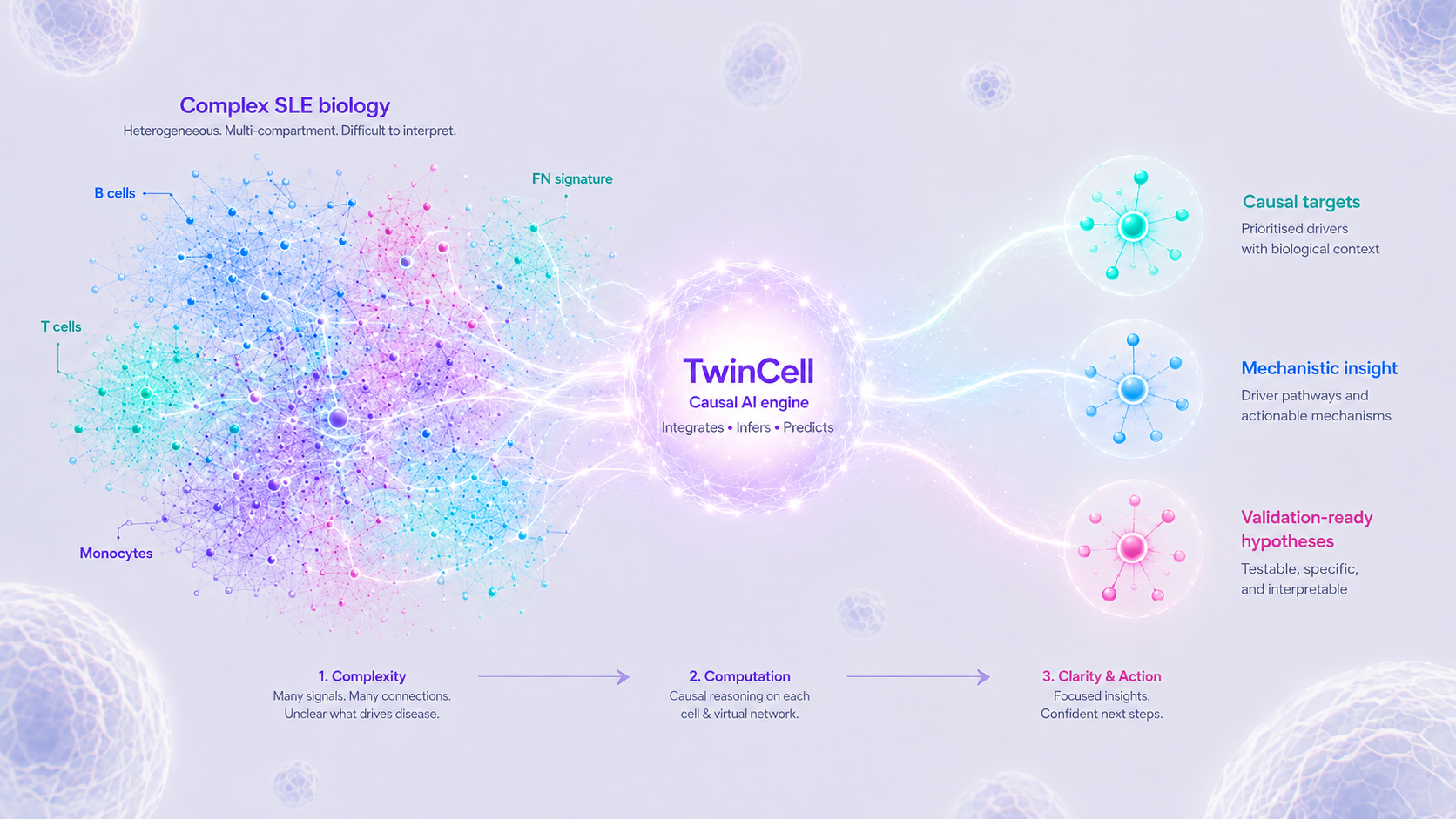
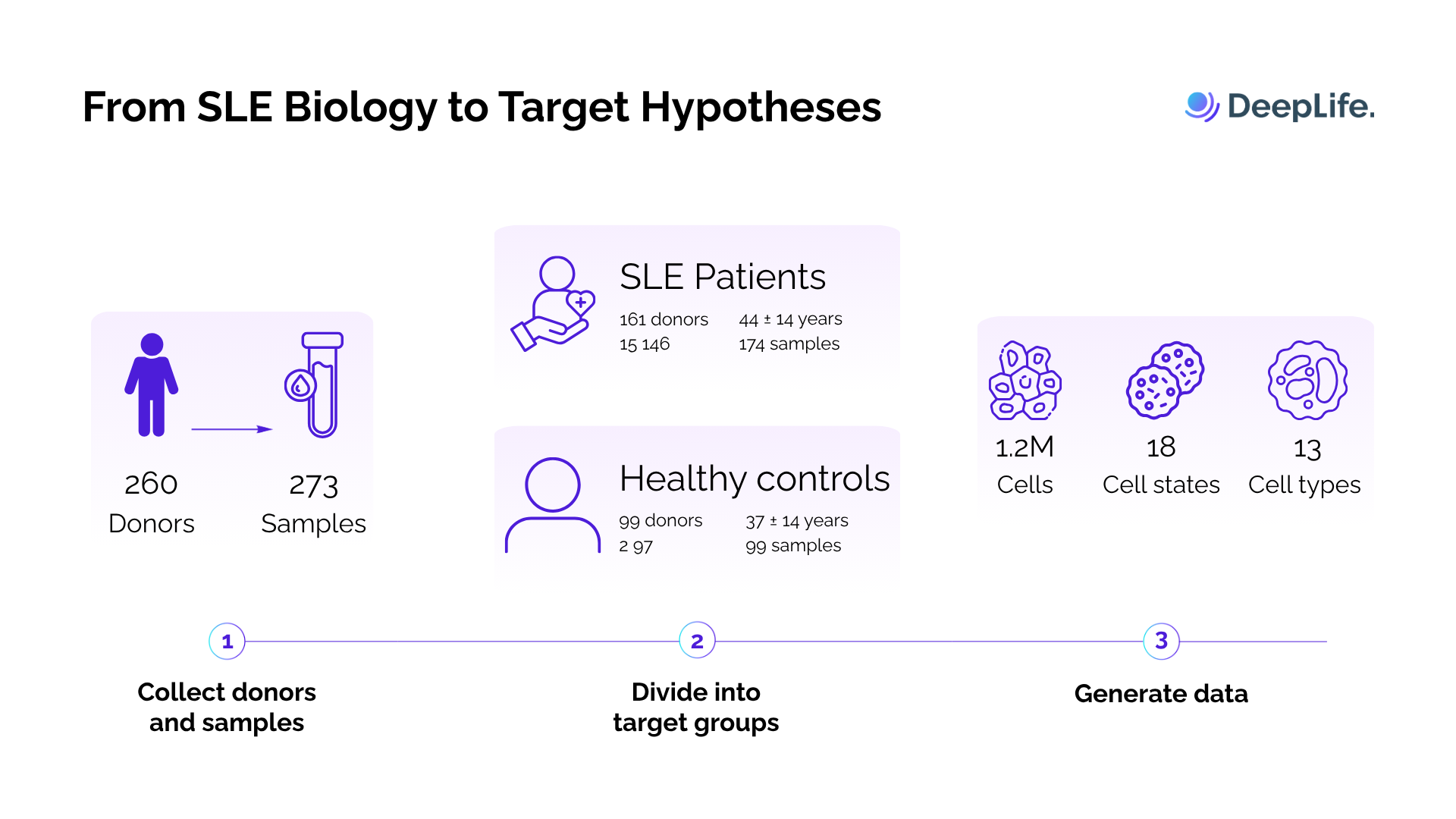
DeepLife reanalysed a public single-cell PBMC dataset in SLE, using TwinCell to generate biologically meaningful target hypotheses.
TwinCell is DeepLife’s causal model layer for therapeutic target prioritisation. It is a Large Causal Cell Model that combines single-cell embeddings with multi-omics networks to identify regulators that drive transitions from diseased to healthier cellular states. The model generalises from in vitro perturbation data to patient-derived cell types and provides biologically meaningful interpretations of its predictions through causal graphs.
Starting from the re-annotated SLE atlas, we modeled disease-relevant immune-cell states using TwinCell, and prioritised targets based on predicted causal influence rather than expression change alone, linking a ranked target hypothesis in a specific cell type to a mechanistic rationale.
What the analysis found in SLE
The analysis focused on B-cell populations as important contributors to SLE-related disease biology, with particular attention to atypical B-cell states.
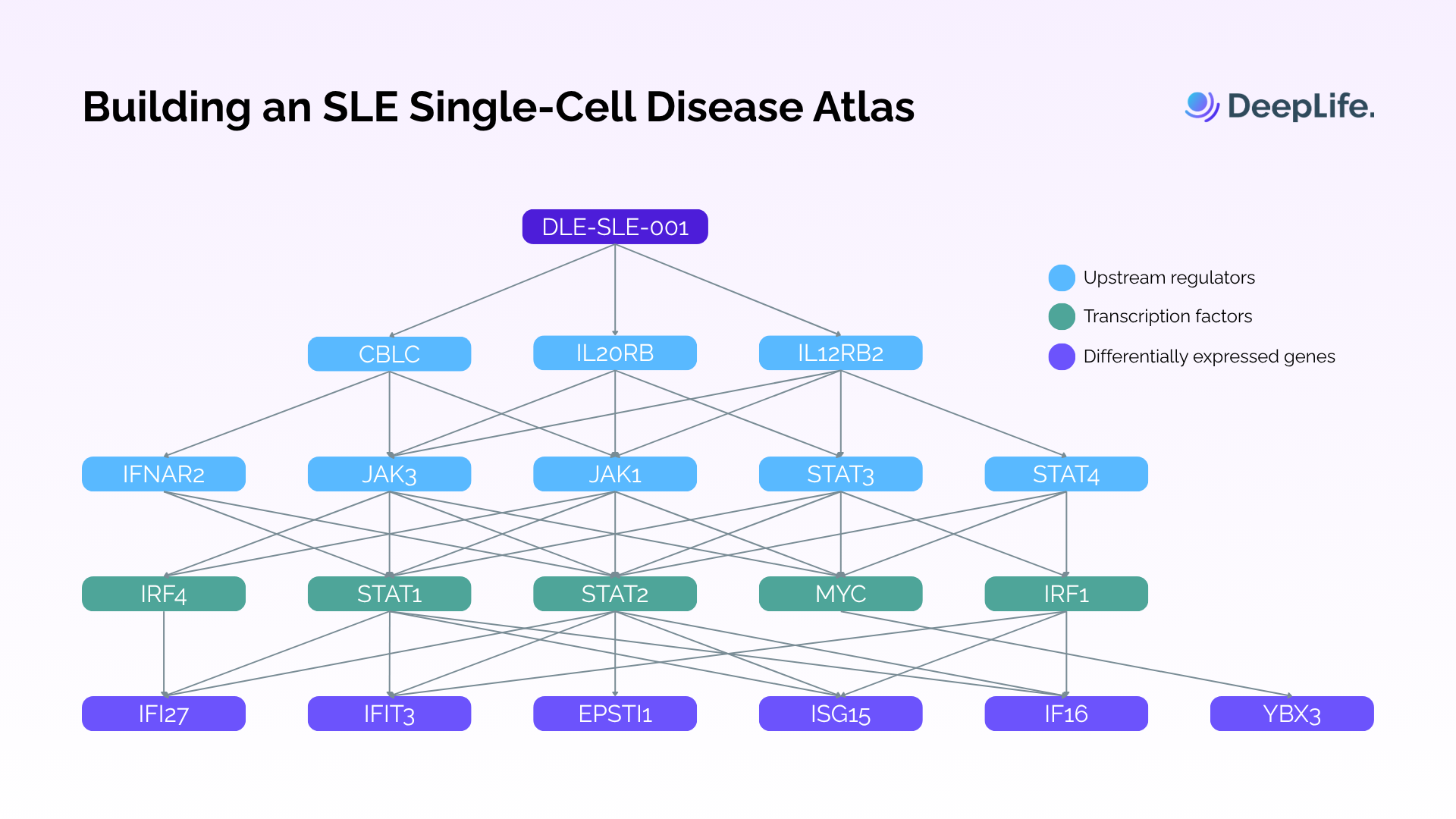
TwinCell recovered known and clinically relevant SLE biology, including pathways connected to type I interferon signalling, Toll-like receptor biology and JAK-STAT signalling, as well as new target hypotheses beyond the most established SLE pathways.
These new target hypotheses constitute a prioritised starting point for validation, supported by cell-type-specific mechanistic insights that discovery research teams can leverage.
Why causal interpretation matters for validation
For scientists and drug discovery teams, a ranked target list is only useful when it can be brought into a disease-relevant biological context. This is where causal target discovery differs from a correlation-only workflow: instead of focusing on genes that are modulated in SLE, TwinCell asks which proteins may help induce a disease-to-healthier-state transition in a defined cellular context. TwinCell’s results help teams prioritize biological validation by revealing underlying mechanisms of action (MoA) and identifying key disease-relevant cell types to guide preclinical development, while also offering critical insights to inform translational studies and patient population targeting.
What this means for SLE and other complex diseases
SLE brings together several challengesthat are common in complex diseases: heterogeneous disease biology, multiplerelevant immune-cell populations, incomplete treatment response and complexcausal mechanisms. New biologics such as belimumab and anifrolumab haveimproved treatment options for some patients, but response remains variable andnone of the available options can be considered curative.
For DeepLife cell-type-specific causalmodelling can help research teams move towards better-structured hypotheses forvalidation. Building on this first pilot, DeepLife has entered a collaborationwith clinicians and scientists from the University of Strasbourg, to access aunique patient population with lupus nephritis supporting novel targetdiscovery for patients in need. Thiscollaboration is one of many DeepLife is committed to, supporting research inhigh unmet medical need indications.
Have a complex disease question or target list to evaluate?
DeepLife can help translate single-cell disease biology into cell-type-specific target hypotheses and validation-read questions.